Congratulations, Dr. Amirah Ellis-Gilliam: From Dissertation to Publication in the Delaware Journal of Public Health
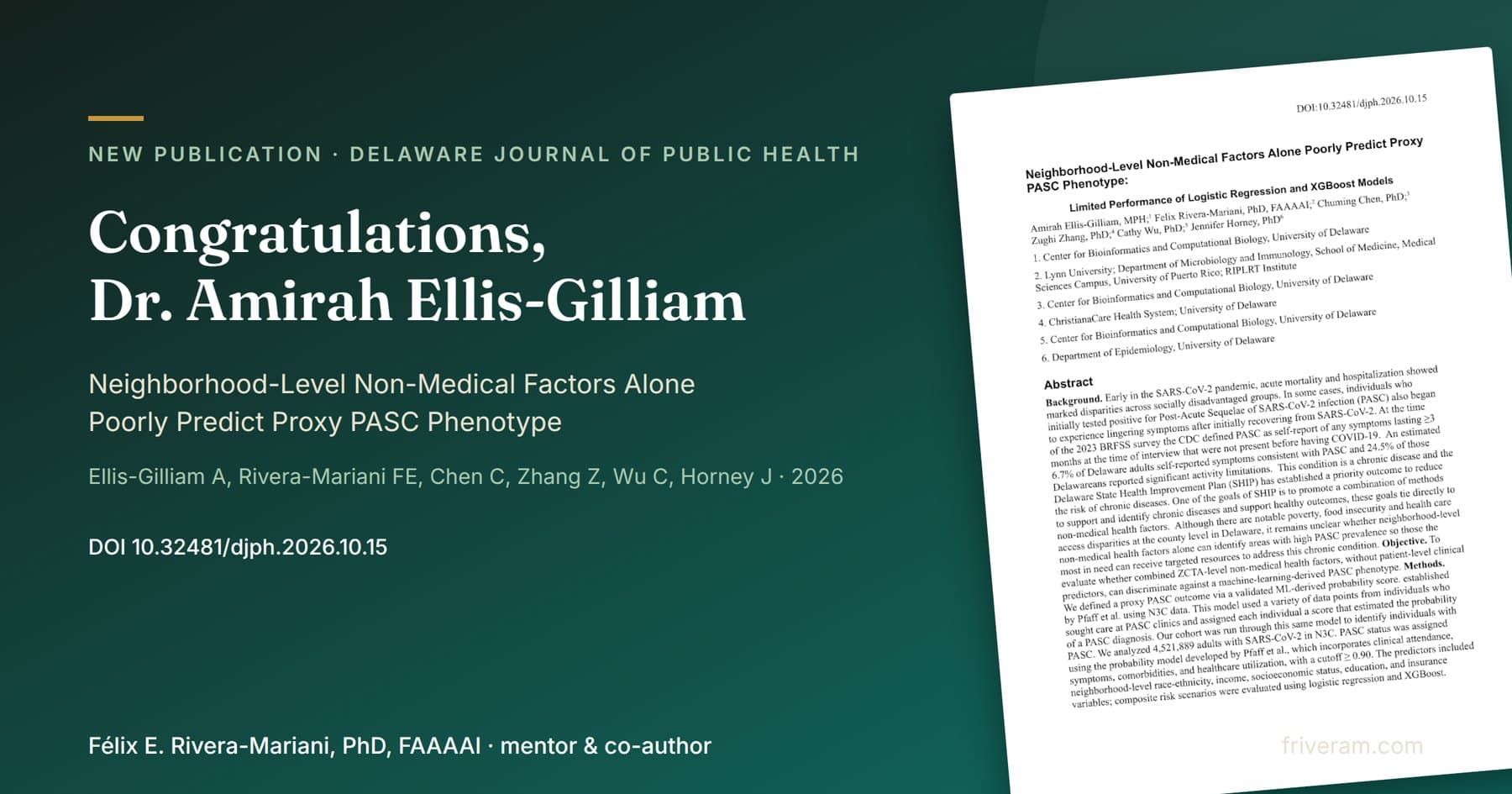
Eleven days ago I wrote about Amirah Ellis-Gilliam's PhD defense at the University of Delaware. Today I get to write the follow-up every mentor hopes for: the first study of that dissertation is now a peer-reviewed publication.
Ellis-Gilliam A, Rivera-Mariani FE, Chen C, Zhang Z, Wu C, Horney J. Neighborhood-Level Non-Medical Factors Alone Poorly Predict Proxy PASC Phenotype: Limited Performance of Logistic Regression and XGBoost Models. Delaware Journal of Public Health, October 2026. DOI: 10.32481/djph.2026.10.15 · Read the article (PDF)
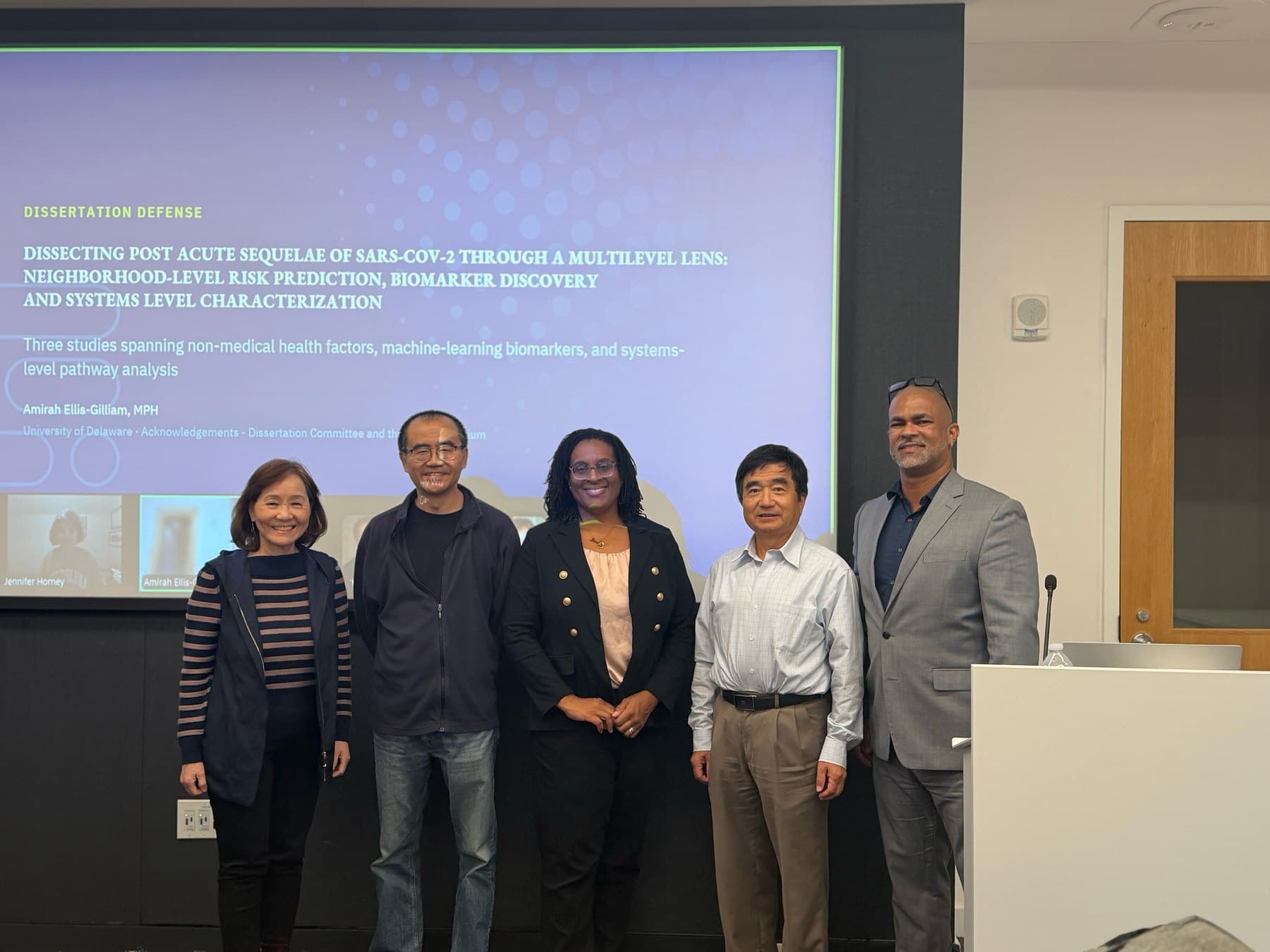
Congratulations, Dr. Ellis-Gilliam. The co-authors are her dissertation committee—Dr. Chuming Chen, Dr. Zugui Zhang, Dr. Cathy Wu, Dr. Jennifer Horney, and me—and I am honored to have my name next to hers.
The question
Post-acute sequelae of SARS-CoV-2 (PASC), better known as Long COVID, is now a chronic disease in its own right. In Delaware, an estimated 6.7% of adults report symptoms consistent with PASC, and about one in four of them reports significant limitations in daily activities. The state's Health Improvement Plan has made reducing chronic-disease risk a priority, and the disparities in poverty, food insecurity, and access to care across Delaware's counties are well documented.
So the paper asks a practical question: if we only know where people live—the social and economic profile of their ZIP-code area—can we identify who is likely to develop PASC, and therefore where to send resources?
How they tested it
Amirah and her co-authors analyzed 4,521,889 adults with SARS-CoV-2 infection in the National COVID Cohort Collaborative (N3C). Because there is still no validated diagnostic test for PASC, cases were defined with a published, machine-learning-derived probability score (the Pfaff et al. model, cutoff ≥ 0.90). The predictors were deliberately limited to neighborhood-level, non-medical factors at the ZCTA level—race/ethnicity, income, socioeconomic status, education, and insurance—combined into composite risk scenarios and modeled with logistic regression and XGBoost, six models in all.
What they found
The answer is a clear no. Logistic regression performed at chance (AUC ≈ 0.50). XGBoost looked a little better on the test set (AUC 0.685–0.689), but that advantage largely disappeared under cross-validation (AUC 0.516–0.523), and the models recovered only 5–6% of true PASC cases (recall 0.05–0.06). Neighborhood-level factors alone cannot discriminate who has PASC at the individual level.
The authors are careful about what that does and does not mean. In their words, the result "does not mean that non-medical health factors do not matter in relation to PASC, rather it means that neighborhood level proxies alone are not the right tool." The disparities are real; area-level averages are simply too blunt to find the individuals behind them. Future models, they conclude, should bring in individual-level clinical characteristics, comorbidity burden, and biomarkers—and a Delaware-specific analysis would show whether the national pattern holds at home.
Why I like a negative result
Null findings rarely make headlines, and many never get written up. This one deserved to be, for two reasons. First, it closes a door that policy makers would otherwise keep trying: a map of neighborhood disadvantage is not a Long COVID screening tool. Second, it opens the right one. The paper's conclusion is exactly the path Amirah's dissertation then followed—from populations to patients to pathways—identifying albumin, alanine aminotransferase, and new-onset lung disease as the signals that actually carry information about PASC. Science moves forward when someone is willing to report, carefully and honestly, what did not work.
Three years ago, Amirah came to me for a bioinformatics consultation. Watching her turn that first conversation into a defended dissertation and now a publication is one of the real rewards of mentoring. Read the paper, and if you work on Long COVID in Delaware or anywhere else, take its message to heart: the people most affected deserve tools that can actually find them.