Congratulations, Dr. Amirah Ellis-Gilliam: A Dissertation on Long COVID, Defended
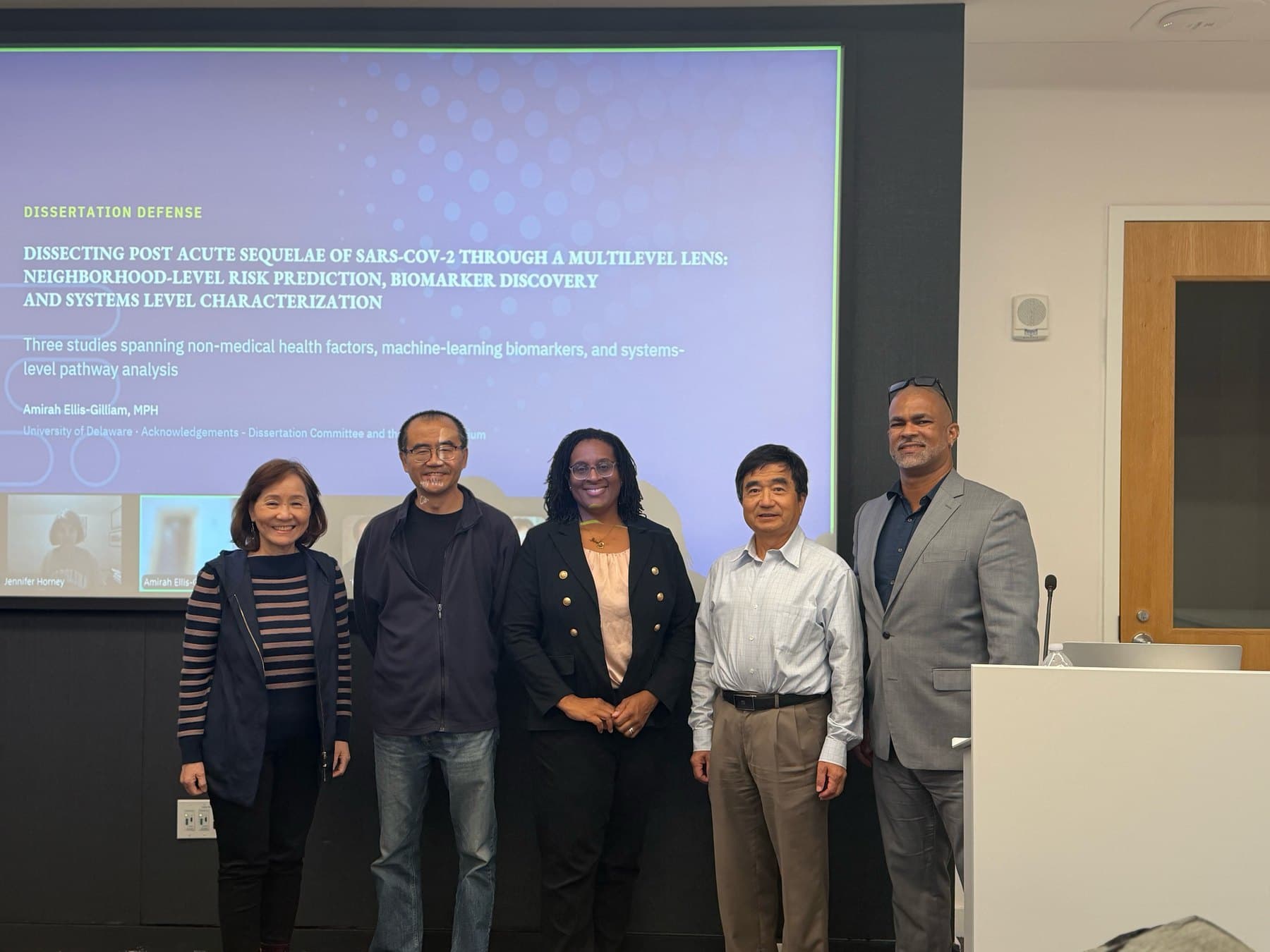
Today, Amirah Ellis-Gilliam, MPH, successfully defended her PhD dissertation in Bioinformatics Data Science at the University of Delaware:
Dissecting Post Acute Sequelae of SARS-CoV-2 Through a Multilevel Lens: Neighborhood-Level Risk Prediction, Biomarker Discovery and Systems Level Characterization
I had the honor of serving on her dissertation committee, and I could not be prouder. Congratulations, Dr. Ellis-Gilliam.
Three studies, one hard question
Post-acute sequelae of SARS-CoV-2 (PASC), better known as Long COVID, affects an estimated 3–9% of people in the United States and up to 10% globally, according to the World Health Organization. Yet there is still no validated screening test for it, and it remains unclear at what level risk can be identified and which biomarkers or clinical features are actually associated with the condition. Amirah's dissertation takes that question apart at three levels.
1. Can neighborhood-level factors predict PASC? In the absence of a validated screening tool, the first study asked whether ZIP-code-tabulation-area (ZCTA) social and economic factors alone—race/ethnicity, income, socioeconomic status, education, and insurance—could discriminate a validated, machine-learning-derived proxy for PASC in a cohort of more than 4.5 million people (N = 4,521,889). Logistic regression performed at chance (AUC 0.50) and XGBoost only weakly (test AUC 0.685–0.689, cross-validated AUC 0.516–0.523, recall 0.05–0.06). The answer is a clear and useful negative: neighborhood-level factors by themselves are not sufficient to predict PASC.
2. Which biomarkers and clinical features are associated with PASC? Using a matched case–control design built from the National COVID Cohort Collaborative (N3C), the second study modeled 21 biomarkers together with clinical features and new-onset diseases using logistic regression, XGBoost, and CatBoost. All models performed moderately (AUC ≈ 0.70), and a SHAP analysis identified the features that mattered most: new-onset lung disease, albumin, alanine aminotransferase (ALT), hospitalization, and respiratory rate.
3. What do albumin and ALT have to do with Long COVID? The third study asked whether those two biomarkers connect to the biological pathways already implicated in PASC. Combining literature mining with pathway analysis—the JensenLab Disease Association database, Enrichr, STRING, Cytoscape, KEGG, Gene Ontology, and Reactome—the results support the growing evidence that PASC is a multisystem immune-inflammatory condition, and they add something new: the albumin and ALT signals point to pathways well beyond liver-specific function.
Taken together, the work moves from populations to patients to pathways, and it is honest about what each level can and cannot tell us. Further research is needed to establish clinical thresholds and validate these findings, and Amirah has laid out exactly where that work should go.
The committee
Amirah's committee brought together epidemiology, bioinformatics, biostatistics, and environmental health:
- Dr. Chuming Chen (chair), Research Professor, Department of Computer and Information Sciences, Delaware Biotechnology Institute, University of Delaware
- Dr. Cathy Wu, Edward G. Jefferson Chair of Bioinformatics & Computational Biology, Professor of Computer & Information Sciences, and Director of the Center for Bioinformatics & Computational Biology, University of Delaware
- Dr. Jennifer Horney, Professor and Founding Chair of the Department of Epidemiology, University of Delaware
- Dr. Zugui Zhang, PhD, FAHA, Director of Biostatistics, Institute for Research on Equity and Community Health (iREACH), ChristianaCare
- and me
How we got here
I met Amirah about three years ago, during a bioinformatics consultation. What began as a technical conversation about data grew into a sustained professional relationship, and when the time came to assemble her dissertation committee, she asked me to serve on it. Saying yes was easy.
Watching a mentee move from a consultation to a defended dissertation is one of the best parts of this work. It is also a reminder that mentoring does not have to happen inside one department or one institution: a single conversation, taken seriously, can turn into years of collaboration. That belief is at the center of how the RIPLRT Institute approaches mentoring, and Amirah's defense is a good example of why.
Congratulations again, Dr. Ellis-Gilliam. Looking forward to the work ahead.