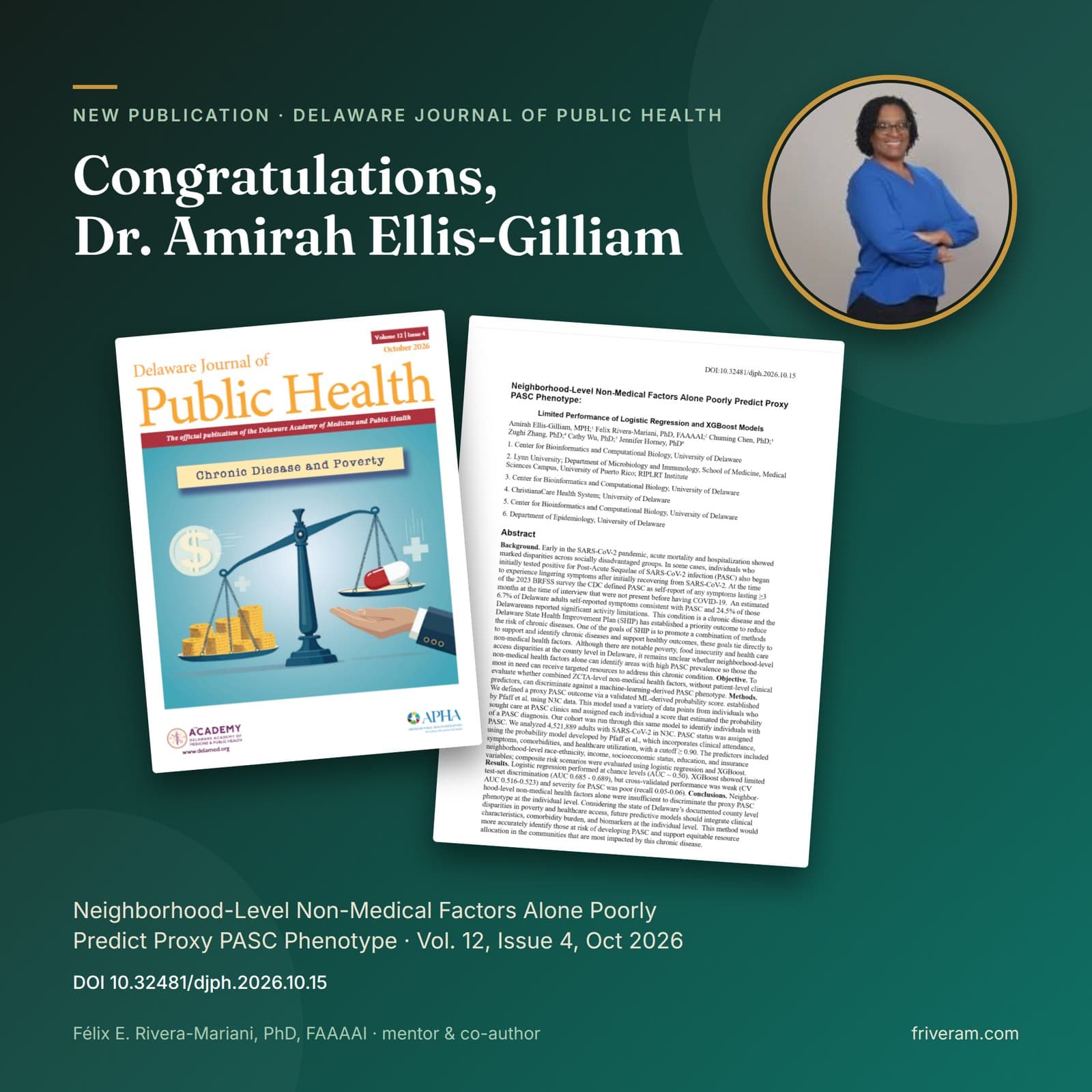
New Publication in Aerobiology: Ambient Fungal Spores and Asthma Healthcare Use in San Juan, 2018–2021
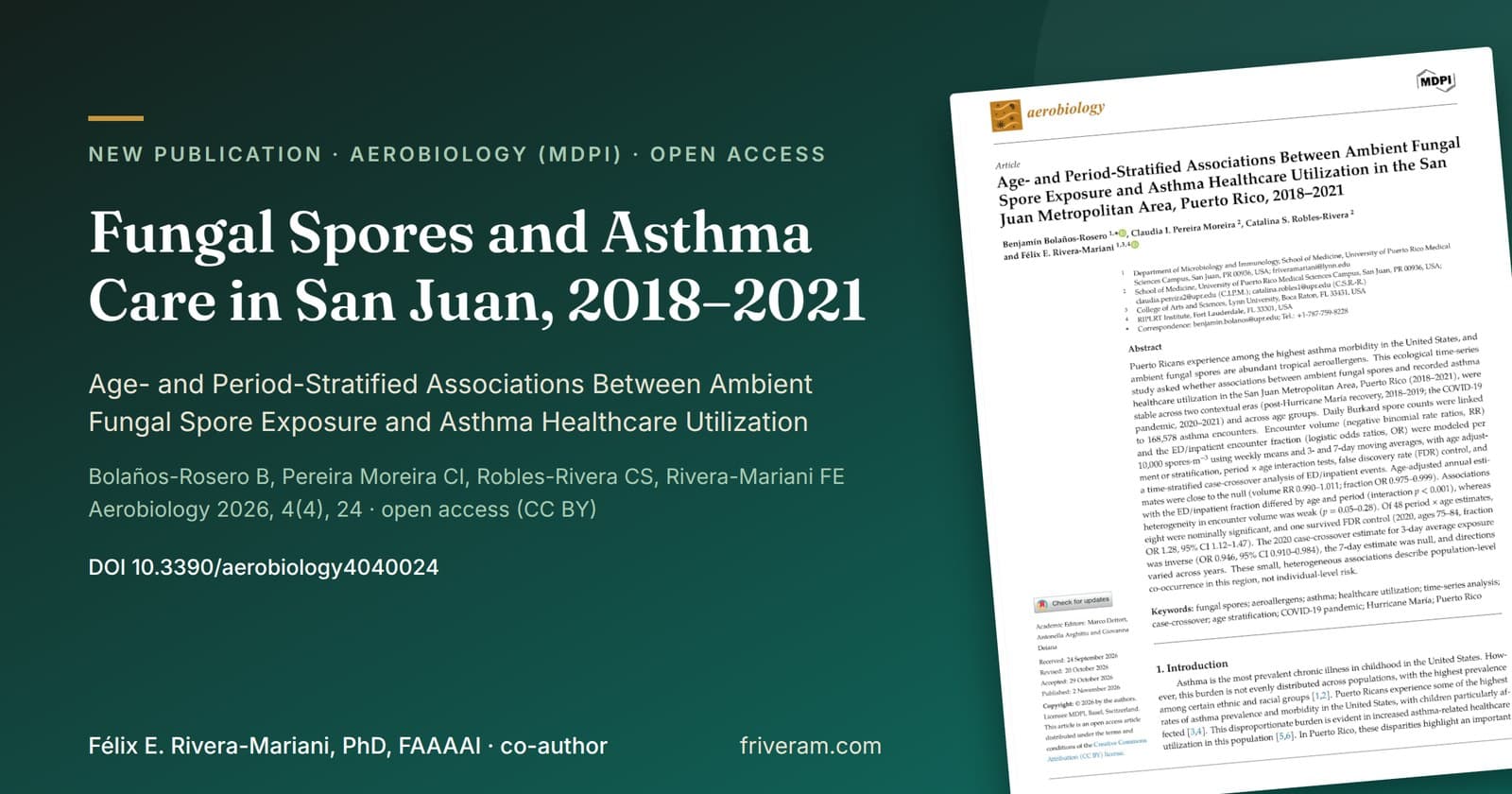
Our new article is out in Aerobiology (MDPI), open access. It asks a question that has followed me since my own training at the University of Puerto Rico Medical Sciences Campus: in a place with some of the highest asthma morbidity in the United States and some of the highest fungal spore concentrations in the air, do the two actually move together—and is that relationship stable across age groups and across very different periods of time?
Bolaños-Rosero B, Pereira Moreira CI, Robles-Rivera CS, Rivera-Mariani FE. Age- and Period-Stratified Associations Between Ambient Fungal Spore Exposure and Asthma Healthcare Utilization in the San Juan Metropolitan Area, Puerto Rico, 2018–2021. Aerobiology 2026, 4(4), 24. DOI: 10.3390/aerobiology4040024 · Read the article (open access)
The study was led by Dr. Benjamín Bolaños-Rosero (Department of Microbiology and Immunology, UPR School of Medicine), who is the corresponding author, and co-authored with Claudia I. Pereira Moreira and Catalina S. Robles-Rivera, trainees at the UPR School of Medicine whom Benjamín and I mentor. I was responsible for the methodology, the analysis code, the formal analysis, and the figures. The RIPLRT Institute has its own announcement on riplrt.com; this is my more personal version.
The question
Fungal spores are the most abundant aeroallergens in Puerto Rico's air, and Puerto Ricans—children especially—carry a disproportionate asthma burden. The four years we studied also span two very different contexts: the recovery after Hurricane María (2018–2019), when storm damage and dampness plausibly increased indoor and outdoor fungal exposure, and the COVID-19 pandemic (2020–2021), when masking, healthcare avoidance, and changed mobility plausibly suppressed both exposure and the measured exposure–outcome association. So instead of asking only "are spores associated with asthma care?", we asked whether that association holds up era by era and age group by age group.
How we tested it
We linked daily total fungal spore counts from the National Allergy Bureau–certified Burkard sampler on the rooftop of the UPR Medical Sciences Campus—the record Benjamín has maintained in San Juan for more than two decades—to 168,578 asthma encounters (emergency department, inpatient, outpatient, and urgent care) among residents of the six municipalities of the San Juan health region: Loíza, San Juan, Trujillo Alto, Guaynabo, Canóvanas, and Carolina. Encounters came from de-identified, aggregate claims provided by the Puerto Rico Health Insurance Administration; Caguas was analyzed separately as a sensitivity case.
For each year we modeled two outcomes per 10,000 spores·m⁻³: encounter volume (negative binomial rate ratios) and the fraction of encounters that were ED or inpatient (logistic odds ratios), using weekly means and 3- and 7-day moving averages, with age adjustment or age stratification, formal period × age interaction tests, false discovery rate control across the 48 period × age estimates, and a time-stratified case-crossover analysis of ED/inpatient events.
What we found
- Age-adjusted annual estimates were close to the null. Rate ratios for encounter volume ranged from 0.990 to 1.011 and odds ratios for the ED/inpatient fraction from 0.975 to 0.999.
- Age and period mattered for severity, not volume. The association with the ED/inpatient fraction differed by age group and period (interaction p < 0.001), whereas heterogeneity in encounter volume was weak (p = 0.05–0.28).
- One estimate survived multiple-testing correction. Of 48 period × age estimates, eight were nominally significant and one held after FDR control: adults aged 75–84 in 2020 (fraction OR 1.28, 95% CI 1.12–1.47).
- No consistent short-term signal. The 2020 case-crossover estimate for 3-day average exposure was inverse (OR 0.946, 95% CI 0.910–0.984), the 7-day estimate was null, and directions varied across years.
What it does and does not mean
We are deliberate in the paper about the limits. The design is ecological: these associations describe population-level co-occurrence of recorded encounters and ambient spores in one region. They do not establish individual-level risk, a biological latency, or the value of exposure-informed asthma management. What the study does show is how easily age structure and era-specific context can distort an unadjusted spore–asthma association—who sought care changed in 2020, and pandemic restrictions overlapped with the dry, low-spore months—so explicit age modeling is not optional in environmental asthma analyses of this kind. The next step is the one we name in the conclusions: cohort studies with spatially resolved exposure assessment, individual-level outcomes, and immunological phenotyping in this high-burden population.
Two decades of spores, two trainees
Papers like this one are only possible because someone counted spores every day for twenty years, and in San Juan that someone is Benjamín. I am grateful for a collaboration that keeps producing questions worth answering. I am equally proud that Claudia and Catalina, who presented early findings from this project at the Alliance for Clinical and Translational Research conference in San Juan in May, are now co-authors on the published article—that is how research training is supposed to work. The study was supported by the Puerto Rico Science, Technology and Research Trust, and the article is published under a Creative Commons Attribution (CC BY) license, so read it, share it, and build on it.